Course 2 · Play
Turns, claims and precedence 行牌
Draw, discard, and the split-second decisions in between: who may claim a tile, who wins the race, and when a kong becomes a liability.
The turn cycle
Turn order runs counter-clockwise, E→S→W→N. Each normal turn: draw 1 from the wall head → optionally declare a self-draw win or a kong → discard 1 face-up into the river 牌河, the discard area inside the wall. One go-around (一巡) means every player has acted once; a 144-tile hand runs about 24 go-arounds if nobody melds.
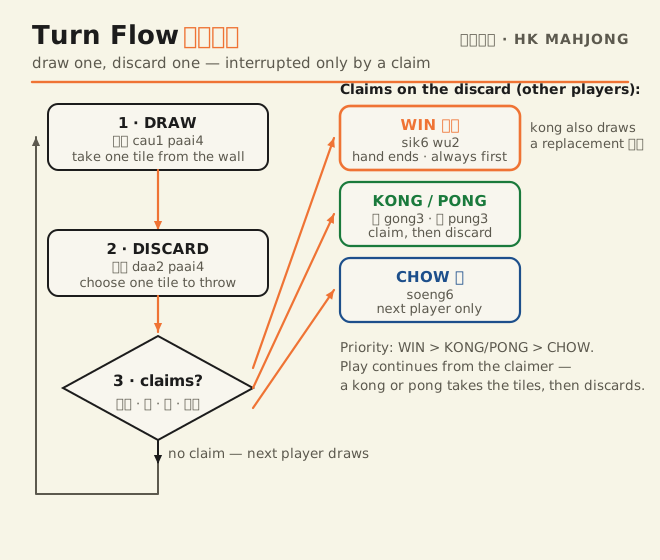
Tournament play is precise: the discard counts only once it clearly lands in the river face-up; it cannot be retrieved; the next player may draw only after the discarder's fingers leave the tile; touching the wall waives your claim on the discard (other players may still claim); and reading tile names aloud is discouraged — a wrong name that causes a missed claim is penalised.
Claims 鳴牌 — taking another player's discard
Only the newest discard may be claimed, and only before the next player has drawn and mixed the tile into their hand. All claims must be spoken — 上 / 碰 / 槓 / 食糊 — vague words like "wait" can be ignored.
| Claim | Cantonese | From whom | You need | Result |
|---|---|---|---|---|
| Chow | 上 (soeng5) | left player only | 2 tiles completing a same-suit run | exposed sequence; then discard |
| Pung | 碰 (pung3) | anyone | a concealed pair | exposed triplet; then discard |
| Kong | 槓 (gong3) | anyone (big kong) / self / own meld | see the three kongs, below | exposed or concealed quad; replacement draw |
| Win | 食糊 (sik6 wu4) | anyone (or self-draw) | a complete hand | hand ends; score it |
A chow or pung skips your draw step: claim → expose the meld → discard. And a tactical note from the tournament rulebook: callers should wait a beat before exposing, so a higher-priority claim can still intercede.
Claim precedence
Win > Kong/Pung > Chow. If two players want the same tile, only the highest-priority claim stands, and an illegal claim has no priority at all. A player who called chow and then hears a pung or kong call may still convert to a win on that tile without penalty.
If two players can win on the same discard, normally only the first to call wins (截糊 zit3 wu4, "head-bump"). Some tables play 無截糊 / 一炮多響 instead: all simultaneous winners are paid, mostly under a discarder-pays-all system. A 十三幺 hand cannot be head-bumped by another hand.
The three kongs
All kongs are declared 槓, expose 4 tiles (locked — they can never return to your hand), and require a replacement draw from the wall tail. Expose first, draw after — drawing first is a foul.
- Concealed kong 暗槓 (am3 gong3): four identical tiles in hand, declared on your own turn, tiles face-down. Not allowed in the same breath as having just claimed a chow/pung — you're mid-discard.
- Big (melded) kong 大明槓: someone discards a tile matching your concealed triplet.
- Added kong 加槓 (gaa1 gong3): on your turn, add the 4th tile to your own exposed pung. Place it unambiguously in the meld area, not the river — an ambiguous motion can legitimately be robbed (see below).
After the replacement draw you re-enter your turn at the decision step — you may even declare another kong, or win. Forgetting the replacement and discarding anyway is a foul (先切牌): uncorrected, you play the hand a tile short (小相公) and cannot win.
Replacement draws 補槓
A kong "consumes" one extra tile, which is why it earns a draw from the tail. Winning on that replacement tile is 槓上開花 — a scoring bonus in its own right. Flower replacements come from the same tail.
Robbing a kong 搶槓
When a player declares an added kong of a tile you're waiting on, you may immediately claim it to win — 搶槓, +1 faan. The tournament rules:
- Only added kongs can be robbed — with one exception: a 十三幺 hand may rob a concealed kong.
- A big kong can never be robbed: a simultaneous win call simply outranks it (win > kong), so the kong fails.
- The declarer must pause a beat after calling 槓 before drawing the replacement — that pause is the robbing window.
HKMA treats robbing as the kong-player's discard (+1 faan) but pays it as if self-drawn — the robber takes the three-payer total. Other tables count an exposed-kong win as a normal discard.
Interrupted flow
After any claim, the claimer discards and play resumes with the player to the claimer's right.
The "passed on it" rule 過水
If a discard would complete your hand and you pass, you cannot claim the same tile from another player in the same go-around — until your next draw you may only win by self-draw or on a different winning tile.
Some tables block both waits after you decline one (pass 1萬 while waiting on 1萬/4萬 → both blocked), with an exception when the declined tile was the lower-value win. Exposing a "win" that violates this rule counts as a false win at some tables.
The draw 流局
The hand is drawn when the last wall tile has been drawn and the final discard goes unclaimed. No payment on a draw — sourced HK rules have no tenpai-payment system. What happens to the dealer is a table choice: tradition repeats the dealer (連莊), faster games and HKMA tournaments pass.
False wins and miscounted hands
Declaring a win you don't have — wrong shape, below the faan minimum, or a win barred by the 過水 rule — is a false win 詐糊 (zaa3 wu2). The standard custom: the false winner pays everyone the limit price, as if each had self-drawn (an 8-faan cap → 3 × the 8-faan self-draw price). HKMA instead deducts the 例牌 score (512 points) and restarts the hand with the same dealer. Exposing half your hand so others can memorise it is also 詐糊.
A miscounted hand 相公 (soeng1 gung1) — too few (小相公) or too many (大相公) tiles — can no longer win once confirmed, even if the count later corrects itself. Tournament play adds card penalties for drawing out of turn, discarding before drawing, kong replacement-order violations and talking or electronics at the table.
Etiquette and table rules
- Agree the table rules first — minimum faan, cap, flowers on/off, payment system, pao on/off, draw-dealer rule. As the saying goes: the day after mahjong was created, it was played at a second table, with a second set of rules.
- Harmony over winning: accept penalties gracefully, don't gloat or grouse, help beginners.
- Play crisply — claims are spoken and immediate; never make the table wait long.
- Don't touch the wall before it's your draw; don't block sight-lines into the river; keep discards tidy and readable.
- Keep your hand to yourself; don't reveal what you drew; signalling between partners is cheating.
- Winning below the minimum → 詐糊, pays everyone the limit.
- Robbing a concealed kong with a non-十三幺 hand — not allowed.
- Chowing from anyone but the left player.
- Forgetting the kong replacement draw → playing short, 小相公.
- Claiming the same tile you passed on earlier in the go-around (過水).
- Counting 2 identical tiles as two pairs in Seven Pairs tables — not allowed.
- Counting a concealed kong as "still concealed" for 門前清 — in HK it isn't.
- Assuming the dealer pays or receives double — no sourced HK rule set does that.